← Back to Blog Home



Session and
Grave improvements: Native crash postmortems via Android tombstones
Native crashes on Android have always been harder to debug than they should be.
The platform has its own crash reporter (debuggerd) that captures the crashing thread, every other running thread, register state, and memory maps into a file called a tombstone. Tombstones have been a part of Android for a long time; in fact, they’ve been there in one form or another since Android’s first commit.
The problem: for most of Android’s life, you couldn’t read tombstones programmatically from inside your app. That left SDK-based native crash reporting (like ours) stuck replicating infrastructure the platform already had — at the cost of binary overhead, incomplete Java frame symbolication, and a C++ fork we had to maintain against a moving AOSP target.
Android 11 (SDK level 30) introduced ApplicationExitInfo. Android 12 (SDK level 31) added access to the trace input stream for ApplicationExitInfo.REASON_CRASH_NATIVE.
Sentry’s Android SDK, as of version 8.30.0, reads that stream on all devices running Android 12 and above and ships it as a native crash event. This dramatically improves crash reporting for Android apps that use native code, whether your team wants just basic crash alerts or deep debugging info.
Let’s dive into how things worked before, what it took to wire it into the SDK without breaking the existing NDK integration, and the improvements these changes bring.
Before tombstones: a fork chasing a moving target
Before tombstone support, the Native SDK (sentry-native) was used in the Android SDK as the primary native error reporting source. Since Android is based on Linux, a considerable part of the SDK could be reused. For those parts that couldn’t, work on integrating Android-specific code began in 2019.
Specifically, the integration of libunwindstack (the AOSP platform unwinder still used today to produce stack traces for debuggerd and, in turn, tombstones) was a key moment for supporting native crashes in Sentry’s Android SDK.
Why, you ask? Because the Native Development Kit (NDK) did not offer a general-purpose stack walker (narrator: it still does not).
libunwindstack is not part of the NDK, but part of the Android Open Source Project (AOSP) platform code and thus is not directly accessible to app developers via the usual means. Sentry forked a repository that patched the platform code to build with the NDK, and since then, maintained that fork without any changes in the upstream patched version. This provided stack tracing capabilities inside the rather complicated Android Runtime (ART) environment, which has mixed stack-traces between classic native code, native code that is part of the VM execution, and Java/Kotlin frames that also appear as native frames, since they are either interpreted, JITed, or AOTed.
While this can already be challenging for a normal stack-walker, it is also a problem from the perspective of symbolication: there are more OEM builds than Sentry can realistically collect platform binaries from. So, while a core set of libraries will likely exist in our backend stores, we cannot rely on all of them being available. Thus, symbolication on Android happens on the client-side.
Considerable restructuring in the platform code, however, made manual upstream alignment very hard over time. In addition to that libunwindstack is a C++ library, which means, while being light on standard library usage, it still needs to be linked against it statically in order to ensure being isolated at runtime from ABI-incompatible versions of the standard library.
It also introduced a couple of challenges:
-
The biggest issue always was size: since we must package binaries for
x86,x86_64,armeabi-v7a, andarm64-v8a, we currently add around 1MiB of stripped binary to every app that needs native error reporting or instrumentation. The Sentry SDK code only accounts for 20% of that size; the rest is libunwindstack and the C++ infra it depends on. -
Incomplete implementation: since the library size is already significant, certain features have been excluded from the build: there is currently no DEX/OAT symbolication (meaning none of the Java frames are symbolicated), and there is incomplete support for locating DWARF CFI in OAT frames, which often leads to dramatically shortened stack traces in release builds.
-
Limited context: Since the
inprocbackend, which handles the crashes on Android, doesn’t stop any threads by design, it also only provides the stack trace of the crashed thread, which, in particular on Android, is often way too little context to uncover the root-cause of a crash
So while all of these are fixable, the effort required is significant and would also lead to a long-term commitment to maintain against the moving target that is AOSP. Introducing tombstone support allows us to fix all the issues mentioned for users who run on Android 12+, which is a significantly growing portion of the incoming events and user base. At the same time, it opens the door to work on better solutions for edge cases.

Android 12+ accounts for ~69% of 2B+ Android error events ingested over the past 30 days.
What tombstones give us
The problems outlined above: size, incomplete traces, missing Java symbolication, and maintenance burden, all stem from replicating the platform crash infrastructure that already exists on the device.
Tombstones fix each of them:
-
All threads, fully symbolicated. Where the
inprocbackend could only capture the crashing thread, tombstones provide stack traces and register sets for every thread at the moment of the crash. On Android, the crashing thread is often just the victim of a problem that originated in another thread. Seeing all of them is the difference between a solvable crash and an enigma. -
Java/Kotlin frames resolved. The platform unwinder has full access to ART internals that a forked NDK build cannot have. DEX/OAT symbolication, which we deliberately excluded to limit binary size, comes for free.
-
No binary overhead for stack traces. Tombstones are produced by the platform’s own
libunwindstack, the same library we have been forking and shipping. The ~1MiB binary weight for all supported ABIs drops to zero for apps that rely on tombstones alone. -
Maintenance shifted to the platform. We consume structured output instead of tracking AOSP restructuring and keeping a C++ fork buildable against the NDK.
-
Register memory context. Memory dumps around pointer values in the crashing thread’s registers show the data being operated on at the point of the crash. (Not yet integrated into the Sentry event payload or UI.)
-
Symbol resolution: Since we now have modules and resolved symbols on the client, we can also strip non-actionable trace contents like runtime-internal frames before sending.
How to use it
Tombstone support is available since version 8.30.0 of sentry-android-core.
If your app runs on Android 12+ and you enable tombstones, you will automatically get more complete reports delivered for all native crashes that affect your app. If you used Native SDK/NDK integration, you will automatically get better stack traces for all your threads and still see the context you created on the native side.
If you have never used the Native SDK interfaces in your native code directly, you can evaluate your options for disabling the NDK integration. If enough users of an app moved on to Android 12+, there is no further use in running both integrations.
If, however, the Native SDK interface is still in direct use, both integrations work together without any visible degradation in user experience.
If you want to turn on the feature, you can do so programmatically via SentryAndroidOptions:
SentryAndroid.init(context) { options ->
    options.isTombstoneEnabled = true
}
Or declaratively in your AndroidManifest.xml:
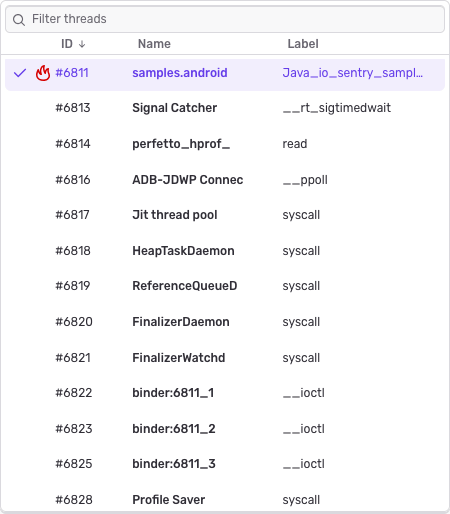
<meta-data android:name="io.sentry.tombstone.enable" android:value="true" />Since tombstones capture every thread at the moment of the crash, you can inspect any of them directly in the issue detail view:
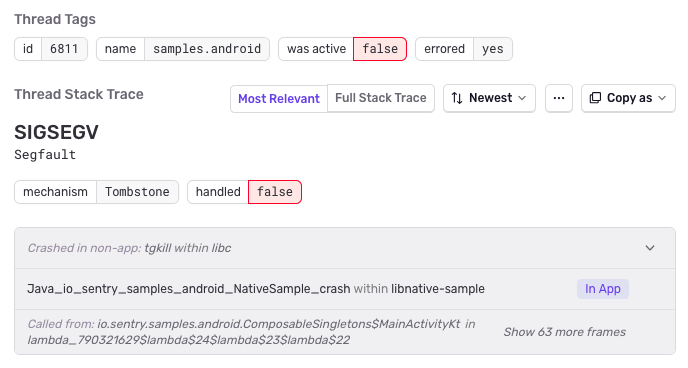
The “Most Relevant” view strips the trace down to the actionable frames, the ones that drive issue grouping and naming, isolating inApp JNI frames, but excluding Jetpack Compose layers:
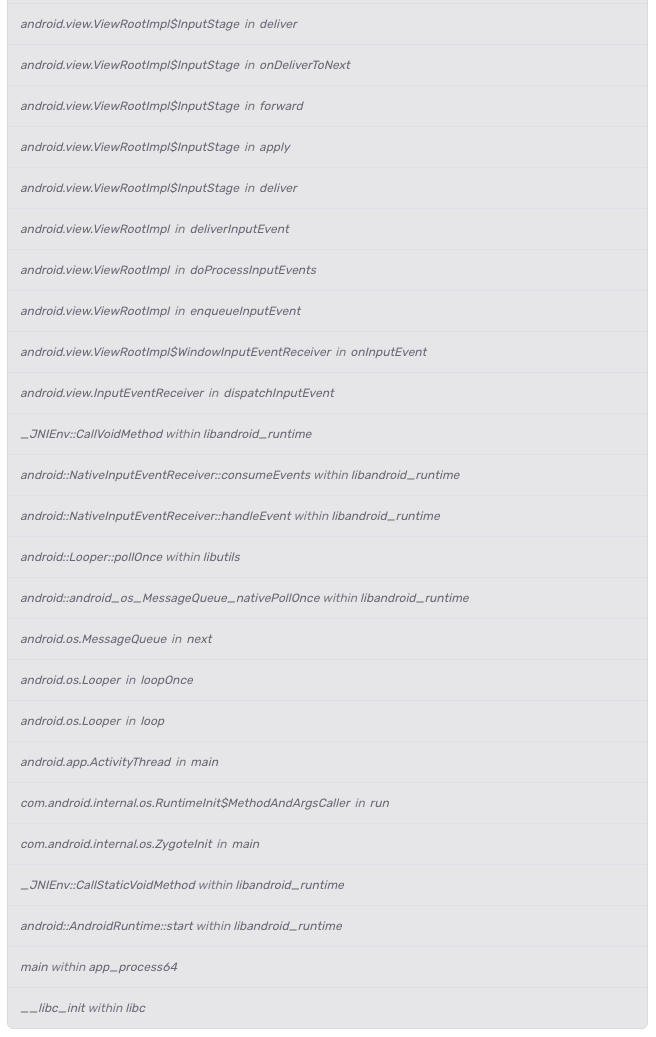
Expanding the collapsed frames reveals the complete picture: from __libc_init through process startup, the Android message loop, the native/Java runtime boundary crossings, and up through the view layer to the crash site:
The implementation challenges
Tombstone support touched on many layers of the SDK because native crash reporting intersects with session management, event deduplication, envelope caching, event enrichment, and the existing NDK integration that already handles the same class of crashes through a completely different mechanism.
Sharing infrastructure with ANR detection
The most immediate architectural challenge was that the SDK already had an integration consuming ApplicationExitInfo: the ANR integration, which handles REASON_ANR. Both integrations need the same lifecycle: query the historical exit list, skip already-reported entries, distinguish the latest (enrichable) entry from older (historical) ones, persist a “last reported” timestamp marker, wait for the previous session to flush, and block until the event is written to disk.
Duplicating this would have been the faster path, but the implementation instead extracted a generic history dispatcher parameterized by a policy interface. Each integration implements the policy (target reason, historical flag, report builder), while the dispatcher owns traversal, ordering, deduplication, and flush coordination. The envelope cache’s timestamp marker system was similarly generalized so both ANR and tombstone markers are handled polymorphically.
This refactoring had a cascading consequence for event processing. The existing ANR event processor was tightly coupled to ANR assumptions and enriched every “backfillable” event (which are events that don’t have access to the live scope of the session they emerge from, but the scope can forensically be reconstructed) as though it were an ANR. With tombstones now also flowing through as backfillable events, the processor was generalized with an enrichment strategy interface. ANR-specific logic (exception synthesis from textual thread dumps, background/foreground fingerprinting, profile-based culprit identification) moved into a dedicated enricher. At the same time, the shared path (scope backfilling, options backfilling, device/OS context) became the generic default that tombstones are fully served by without needing their own enricher.
A considerable part of this new infrastructure can now be reused for other ApplicationExitInfo categories, likely even when the resulting artifacts won’t be events (but rather entries in SDK client reports).
Coexisting with the NDK integration
The deeper problem was that tombstones and the existing Sentry NDK integration (using sentry-native-ndk) report the same crash. The Native SDK catches the signal at runtime via its own signal handler and writes an envelope to the “outbox”. The tombstone is generated by the platform’s debuggerd, which is invoked after the Native SDK’s signal handler chains to the previous handler, but the tombstone only arrives through ApplicationExitInfo on the next launch, after the process has been killed.
If both integrations are active, every native crash produces a duplicate. We need both to get the full picture: the richer stack traces, thread coverage, and up-to-date memory maps from the tombstone, combined with user-supplied scope data from the Native SDK. So we can’t simply turn one off in favor of the other.
Solving this required correlating the two events by timestamp (within a 5-second tolerance) and merging them into one. The correlation itself was trivial. The complexity came from the different paths the two events take before they can be merged.
The Native SDK serializes envelopes to a shared app directory (the “outbox”), which acts as a signal to the Android SDK that an envelope is ready to send. For a native crash, this signal arrives too late to be picked up by the normal outbox sending infrastructure during the crash. So, on the next start, that infrastructure loads every envelope fully into memory, because its sole purpose is to send them to the backend. If we reused it for merge discovery, we would deserialize every queued envelope into memory just to find the one native crash event worth merging. On a device that has been offline and accumulated envelopes, this means a spike in memory pressure and CPU load for what is almost always a single match.
Instead, a lightweight scan phase streams through each envelope file, parsing only item headers and extracting the platform and timestamp fields via streaming JSON, without deserializing the full event. A bounded input stream tracks position within each envelope item and skips unread bytes to correctly advance to the next item. Full deserialization only happens once a timestamp match is found. The resulting streaming envelope/event parsing infrastructure can likely be reused in other parts of the SDK.
The merged event carries a TombstoneMerged exception mechanism (alongside the existing Tombstone and signalhandler mechanisms) so the backend, developers, and customers can distinguish provenance.
Session and crashedLastRun lifecycle
Native crash reporting interacts with session tracking in ways that require careful coordination. When the tombstone integration processes a crash, it needs to end the previous session as crashed and set crashedLastRun to true. But the NDK integration has its own mechanism for this: a crash marker file checked by the session finalizer on next launch.
A dedicated marker hint (deliberately distinct from the one used for ANRs) was introduced so that the envelope cache can recognize tombstone events during session persistence: when it sees the hint, it ends the previous session as crashed with the crash timestamp. The session finalizer then detects the already-crashed state and sets crashedLastRun accordingly, without re-processing the NDK crash marker. Crucially, the native crash marker file is still cleaned up regardless of whether the tombstone integration handled the crash. Otherwise, the NDK path would re-report it on every subsequent launch.
The protobuf dependency problem
Android tombstones use a protobuf format defined in AOSP (tombstone.proto). The initial implementation used protobuf-javalite for decoding, which immediately caused version conflicts for SDK consumers already using protobuf (usually via Firebase). Within a month of the initial release, we replaced it with epitaph, a handwritten decoder for the tombstone protobuf encoding, free of transitive dependencies and weighing around 30KiB. We also added a scheduled CI workflow to monitor AOSP for changes to the tombstone protobuf schema, so we know early if any consequential format changes land in the platform.
The unifying theme across these challenges is that native crash reporting is not a self-contained feature. It sits at the intersection of the SDK’s event pipeline, session lifecycle, disk caching, and the existing NDK integration, each of which had been designed with the assumption that it was the only actor in its domain.
Adding tombstone support meant teaching these components to share: the history dispatcher with ANR detection, the outbox with the NDK integration, the session finalizer with a new crash source, and the event processor with a new category of event. We chose refactoring over duplication at each of these intersection points, which made the initial PRs larger and the review cycles a bit longer, but left the architecture at least as clean as we found it. Especially the common Java SDK core did not see any behavioral changes.
Closing the gap
Tombstone support closes a gap that has existed since Sentry first shipped native crash reporting on Android: the difference between what the platform knows about a crash and what the SDK could tell you.
While that gap might seem arbitrary since we could replicate parts of the platform’s own crash infrastructure inside the app, it only happened by paying the cost of binary size, maintenance burden, and still incomplete results. With ApplicationExitInfo providing programmatic access to the same data that debuggerd produces, we can now offer richer crash context with less overhead and fewer moving parts.
Of course, the limitation is real: this only works on Android 12 and above. For older devices and apps that need instrumentation of their native code beyond error reporting, the NDK integration remains available, and the two coexist cleanly. But with Android 12+ now representing 75% (according to apilevels.com, as of 03/2026) of cumulative usage distribution, the balance has tipped. For most apps, tombstone support is the primary native crash reporting path today, and sentry-native-ndk is the fallback.
Tombstone support is available in sentry-android-core 8.30.0 and above. See the Android SDK docs for configuration details and guidance on whether to keep or drop the NDK integration for your app.